Who gets hurt, and how
This section supports Domain I's coverage of AI risks and responsible-AI principles [S1]. A model is a mathematical or computational representation used to produce outputs from inputs. An AI system is an engineered system that generates outputs such as content, forecasts, recommendations, or decisions for human-defined objectives [S4]. Here, deployment means putting an AI system into use in a real workflow.
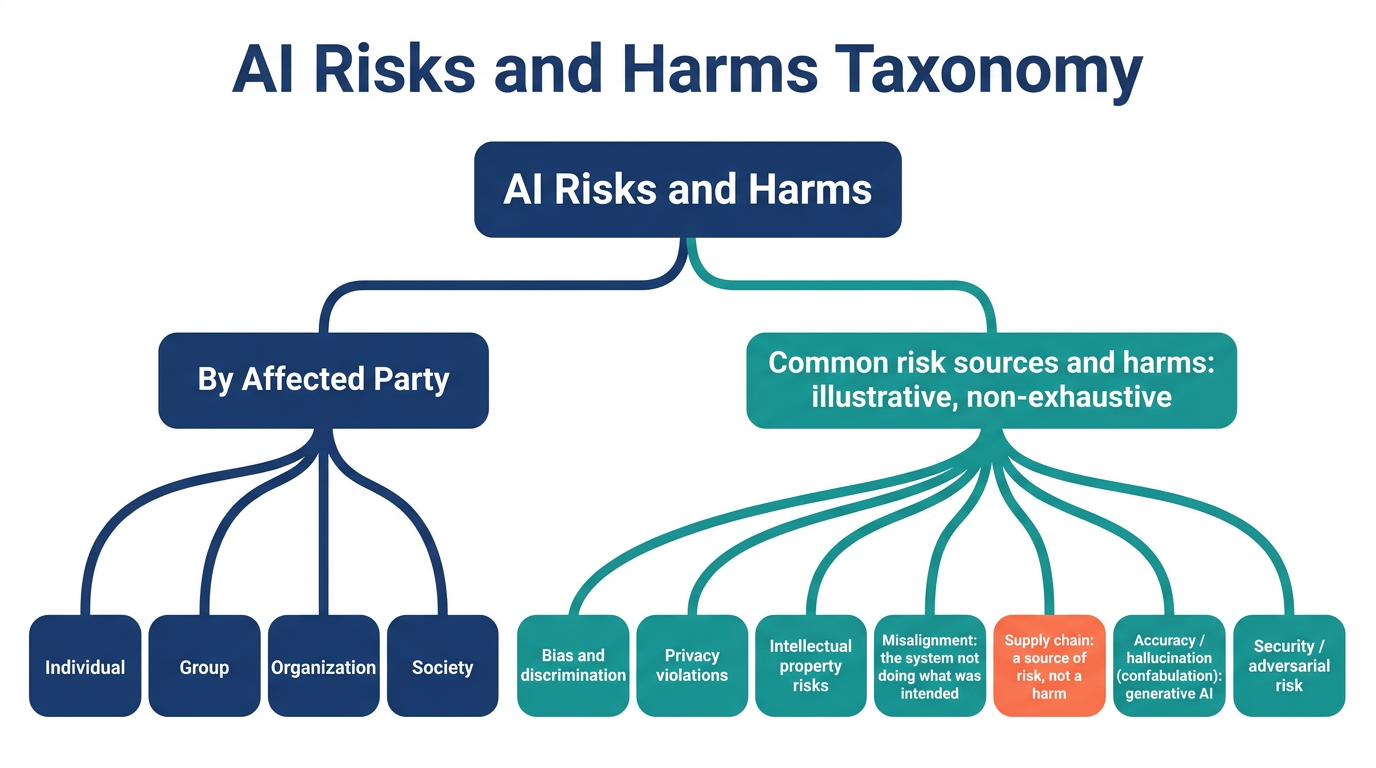
The four lenses below are a noncanonical academy grouping, based on NIST's broader impact scope, not wording attributed to the BoK [S5, section 1.1, "Understanding and Addressing Risks, Impacts, and Harms," pp. 4-5, Figure 1]. The lenses are individuals, groups, organizations, and society. These lenses can overlap in an incident.
- Individuals: Establish the consequence for a person, such as the resident's delay in the illustrative scenario below. Ask what evidence supports it and what remedy is needed. Privacy and opaque decisions require their own investigation when relevant [S10]. Illustrative academy extension: If translation tasks are automated, investigate actual staffing decisions and worker transitions before claiming job displacement. This extension is not part of the original incident.
- Groups: Look for a shared pattern or barrier, such as consistently less reliable notices for a language group. Do not infer the pattern from one case or equate a difference with unlawful discrimination [S5, section 3.7, "Fair – with Harmful Bias Managed," pp. 17-18]. Illustrative academy assessment: In the agricultural example below, investigate whether different access to field visits changes economic opportunities before claiming increased economic inequality.
- Organizations: Identify what the operator or supplier must restore and what costs or obligations it bears. Keep the organization's loss separate from harms its system causes to others [S5, section 1.1, "Understanding and Addressing Risks, Impacts, and Harms," pp. 4-5, Figure 1]. Academy assessment examples: Investigate operational disruption, financial costs, applicable legal and regulatory obligations, and possible reputational effects separately. The municipality's correction costs below are scenario facts; lasting distrust and legal violations are not. In the agricultural example, describe any mismatch between the prediction target and current service needs directly, then test intended use and inconsistent outcomes [S5, MAP 1.1 and MANAGE 2.4].
- Society: Examine effects on shared institutions, public information, or resources. Establish scope and attribution rather than claiming that everyone is affected equally [S5, section 1.1, "Understanding and Addressing Risks, Impacts, and Harms," pp. 4-5, Figure 1][S11]. Illustrative academy extension: An actor might alter a notice to impersonate an official and manipulate public opinion. Investigate authorship, deceptive intent, distribution, and effects rather than treating the translation error below as deliberate manipulation. To assess possible effects on social cohesion, investigate participation and cooperation directly; neither a copied error nor disagreement establishes community division. These are assessment examples, not established consequences of the original incident.
Academy harm analysis: a noncanonical recording method
Record three separate entries rather than using them interchangeably:
- Causal pathway: How could the incident happen? Examples include a false generated instruction, an external dependency, inappropriate data processing, and ineffective human review. NIST addresses these issues through its risk-management framework and generative AI risk profile [S5][S11].
- Risk or harm category: What interest is threatened, or what adverse consequence occurs? NIST's impact scope includes physical, psychological, economic, rights-related, organizational, and societal consequences; its generative AI profile also addresses confabulation, information integrity, harmful bias, and human-AI configuration risks. Use those sources to distinguish a possible safety or unequal-access risk from an evidenced consequence such as delay or correction costs [S5, section 1.1][S11]. A risk is a possibility to assess; an observed harm needs evidence.
- Harm bearer: Who experiences the consequence? Record the relevant lens as individuals, groups, organizations, or society, then identify the affected person, group, organization, or shared institution or resource [S5, section 1.1].
An external supplier is a dependency, not itself a harm. An invented instruction is an output failure, not proof of injury. A municipality is a possible harm bearer, not a risk category.
One compound incident across all three axes
Illustrative academy scenario, invented for this lesson: A municipality uses an external AI service to translate emergency notices. An approved notice directs residents to Shelter A. For one language, the service generates an instruction to go to Shelter B, which is closed. A reviewer sees only the translated text, not the approved original, and cannot pause publication. Other municipal channels copy the translation. A resident follows it and loses time reaching an open shelter. The municipality pays for corrected notices and manual translation.
These facts are part of the invented scenario. They are not findings about a real municipality.
| Incident evidence | Causal pathway | Risk or harm category | Harm bearer |
|---|---|---|---|
| The generated destination differs from the approved notice. | Confabulation or another output error, to be investigated. | Safety risk from inaccurate information; injury is not established. | Individuals: residents who might rely on the instruction. |
| The reviewer lacks the original and cannot pause publication. | Ineffective human-AI configuration and intervention. | Human-AI configuration risk, with possible safety and organizational consequences. | Individuals: residents exposed to the error. Organizations: the municipality responsible for the workflow. |
| Other channels repeat the notice. | Distribution through trusted channels. | Information integrity risk; wider institutional damage is not established. | Individuals: readers. Society: the shared public information service, if wider effects are established. |
| A resident travels to the closed shelter. | Reliance on the incorrect instruction. | Observed delay; further injury is not established. | Individuals: that resident. |
| Only one language version contains the error. | Unequal output quality across language versions. | Possible harmful-bias and unequal-access risk requiring investigation, not an automatic legal finding. | Groups: the affected language group. |
| The municipality funds corrections and manual translation. | Recovery after the output and workflow failures. | Observed financial costs and operational consequences. | Organizations: the municipality. |
The analytical categories draw on NIST's treatment of confabulation, information integrity, human-AI configuration, harmful bias, and risk impacts [S11][S5, section 1.1]. The scenario does not establish why the model produced the error, a privacy violation, supplier misconduct, deliberate manipulation, lasting distrust, or wider social division.
Investigate the pathways
Output, distribution, and reliance
Verify the instruction against the approved original. Then trace copies and corrections separately. NIST identifies confabulation and information integrity as generative AI risk categories [S11]. A corrected original does not show that every copied notice has been corrected.
Assess the actual task, data, and system boundary rather than relying on a capability label. Distinguish retained information supplied as context from machine learning that changes a model, and inspect application storage separately from the context used for an output [S4][S5]. For generative systems, verify consequential answers and proposed steps against evidence and task constraints; fluent explanations or empathetic wording do not establish correctness or human-like understanding [S11]. If an agent directs its own tool use and steps, inspect its permissions and action limits because this increases autonomy [S19].
Examine the review workflow, not just the model. For high-risk AI systems within its scope, EU AI Act Article 14 requires effective human oversight, including appropriate ability to understand limitations, interpret outputs, disregard or reverse outputs, and intervene or interrupt operation [S8, Article 14]. This does not mean every municipal translation service is legally classified as high-risk.
Data, rights, security, and dependencies
If the workflow processes personal data, review its purpose, lawful basis, access, retention, and disclosure. GDPR Article 5(1)(c) requires personal data to be adequate, relevant, and limited to what is necessary for the processing purpose [S9]. Public availability of material does not settle the separate intellectual property questions identified in NIST's generative AI profile [S11].
Inventory external models, data, software, and services. Investigate relevant information-security and dependency failures rather than assuming that an external supplier caused this incident [S11][S12].
Unequal outcomes and intended purpose
Compare relevant language versions, errors, access, and consequences. NIST treats harmful bias as a risk that can arise across the AI lifecycle [S5, section 3.7, "Fair – with Harmful Bias Managed," pp. 17-18]. A measured difference is an investigation finding, not by itself a legal conclusion.
Illustrative academy mechanism: An agricultural advisory service predicts which farms should receive field visits using historical selections as labels. Those records contain fewer farms that needed scheduling assistance. Reviewers investigate whether reproducing past selections misses current need. They test the data, target, and deployment process rather than assuming a particular proxy or discriminatory effect.
Turn findings into governed action
Use governance, operating controls, and corrective action throughout use, not a one-time sign-off.
- Assign responsibilities and involve relevant expertise. NIST calls for documented roles and responsibilities and diverse, multidisciplinary participation. For this illustrative incident, include translation expertise, service operations, technical staff, and affected-language representatives [S5, GOVERN 2.1 and GOVERN 3.1].
- Make intervention workable. Test whether authorized staff can detect the problem, stop automated publication, and use a verified alternative. NIST calls for responses to previously unknown risks and mechanisms to supersede, disengage, or deactivate systems with outcomes inconsistent with intended use. For applicable high-risk systems, EU AI Act Article 14(4)(e) separately addresses intervention or interruption through a stop button or similar procedure that allows a safe halt [S5, MANAGE 2.3-2.4][S8, Article 14(4)(e)].
- Document and verify the response. NIST calls for communicating and tracking incidents and errors, response, recovery, and change management. ISO/IEC 42001 addresses nonconformity and corrective action: respond to the nonconformity, address causes as needed, and review whether corrective action worked [S5, MANAGE 4.3][S12, clause 10.2]. In the scenario, correct the notice, investigate the failed review process, and verify corrections across copied channels.
- Continue lifecycle review. Maintain policies, responsibilities, monitoring, and reassessment as the system, supplier, data, or use changes [S12][S5, MANAGE 4.1].
Summary and concept map
Trace pathway → risk or concrete harm → bearer → control → evidence of effectiveness. The arrows are an academy reasoning aid, not a canonical taxonomy.
For controls, see the canonical cards for cross-functional collaboration, human in the loop, fail-safe, data minimization, deidentification, bias mitigation, and AI lifecycle. Their legal and framework scope differs: GDPR data minimisation is in Article 5(1)(c), high-risk AI oversight is in EU AI Act Article 14, and NIST's risk-response, intervention, and monitoring practices appear in MANAGE 2.3-2.4 and MANAGE 4.1 [S9][S8][S5].
The concepts
confabulation
Domain IThe system gives a wrong answer that sounds convincing.
The system gives a wrong answer that sounds convincing.
Think of it as Illustrative analogy: someone fills a gap in directions with a plausible but nonexistent turn.
Where the simple version breaks: The analogy suggests human intent. An incorrect output does not establish intent to deceive.
Precisely: Assess factual support separately from fluency and separately from the consequences of reliance [S11].
The problem: Confabulation is confidently presented false or erroneous content from a generative AI system [S11].
What must be true
- Separate convincing presentation from accuracy.
- Identify consequential claims and instructions.
- Verify them against reliable evidence.
- Distinguish the output error from subsequent reliance and harm.
- Assign responsibility for correction.
The assumption to question: That fluent or confident wording is evidence of accuracy.
Rebuilding it
- Identify consequential claims.
- Verify them before consequential use.
- Withhold or correct unsupported instructions.
- Evaluate whether the response reduces recurrence [S5, MANAGE 4.3].
Assess factual support separately from fluency and separately from the consequences of reliance [S11].
Traps
- Confident wording proves reliability.. Presentation and factual support are separate questions.
- An incorrect output proves deliberate deception.. The error alone does not establish intent.
In the illustrative emergency-notice incident, the generated destination differs from the approved notice. Reviewers investigate that output error without assuming its technical cause.
- What makes an output convincing without making it correct?
- Which evidence would establish the correct evacuation instruction?
information integrity risk
Domain ICan people rely on the information reaching them?
Can people rely on the information reaching them?
Think of it as Illustrative analogy: several noticeboards copy an incorrect announcement. Fixing one leaves the others unchanged.
Where the simple version breaks: Repetition does not itself prove falsehood, belief, or action.
Precisely: Review accuracy, authenticity, distribution, and correction as distinct evidence questions [S11].
The problem: Information integrity risk concerns the reliability of information and the ability to distinguish trustworthy content from false or misleading content [S11].
What must be true
- Identify content, source, and distribution channels.
- Check accuracy and authenticity.
- Separate the initial error from its spread.
- Distinguish reach from demonstrated reliance.
- Plan corrections across affected channels.
The assumption to question: That correcting the original automatically corrects every copy.
Rebuilding it
- Trace the content's origin.
- Identify where it was repeated.
- Assess reliance and consequences.
- Verify that corrections reach the affected channels.
Review accuracy, authenticity, distribution, and correction as distinct evidence questions [S11].
Traps
- Only deliberate misinformation threatens information integrity.. Accidental false content can also undermine reliable information [S11].
- A large audience proves influence.. Reach, belief, and action require different evidence.
In the illustrative emergency-notice incident, reviewers trace the copied translation and verify corrections separately from correcting the first publication.
- How does an output error differ from its wider distribution?
- What evidence would show that copied notices were corrected?
bias
Domain ILook for a repeated tilt, not just one wrong answer.
Look for a repeated tilt, not just one wrong answer.
Think of it as Illustrative analogy: a scale repeatedly reads too high.
Where the simple version breaks: A scale does not explain social disadvantage. Investigate the data, objectives, and deployment context.
Precisely: Bias assessment spans technical and social sources across the lifecycle [S5, section 3.7, "Fair – with Harmful Bias Managed," pp. 17-18].
The problem: Bias is a systematic tendency in data, measurement, or system behavior that can distort results; NIST distinguishes systemic, computational or statistical, and human-cognitive sources of harmful bias [S5, section 3.7, "Fair – with Harmful Bias Managed," pp. 17-18].
What must be true
- Trace a plausible mechanism before choosing a remedy.
- Historical selections used as labels may not represent current need.
- Inspect missing cases, measurement choices, and the training target.
- Compare relevant errors and outcomes.
- A group difference is not by itself a legal finding.
The assumption to question: That reproducing historical decisions establishes suitability for present needs.
Rebuilding it
- Inspect how records became labels.
- Examine what the objective rewards.
- Test the proposed mechanism.
- Evaluate remedies and their effects on relevant groups [S5, MEASURE 2.11].
Bias assessment spans technical and social sources across the lifecycle [S5, section 3.7, "Fair – with Harmful Bias Managed," pp. 17-18].
Traps
- Any incorrect output establishes bias.. One error does not establish a systematic tendency.
- A group difference automatically proves unlawful discrimination.. The pattern, treatment, context, and applicable law need investigation.
In the illustrative agricultural advisory mechanism, reviewers test whether predicting past field-visit selections reproduces unequal access instead of identifying present need.
- What separates bias from a random error?
- How could historical labels differ from the service's intended purpose?
discrimination
Domain IAsk whether people receive unfair treatment, not merely whether scores differ.
Ask whether people receive unfair treatment, not merely whether scores differ.
Think of it as Illustrative analogy: an apparently neutral access rule may exclude one community in practice.
Where the simple version breaks: The analogy does not establish legal liability, exceptions, or justification.
Precisely: Fairness testing and legal analysis inform one another but answer different questions [S5, section 3.7, "Fair – with Harmful Bias Managed," pp. 17-18].
The problem: For risk assessment, discrimination concerns unfair treatment of people or groups; NIST connects fairness with managing harmful bias and discrimination. A legal finding depends on applicable law and facts [S5, section 3.7, "Fair – with Harmful Bias Managed," pp. 17-18].
What must be true
- Start with treatment or access, not only a model score.
- Identify the people and decisions affected.
- Investigate relevant characteristics and comparison cases.
- Use bias testing as evidence, not as a legal verdict.
- Obtain jurisdiction-specific legal assessment where needed.
The assumption to question: That a technical performance comparison alone settles whether treatment is unlawful.
Rebuilding it
- Identify the treatment.
- Trace how outputs influenced it.
- Investigate differences and explanations.
- Document the legal assessment and test any remedy.
Fairness testing and legal analysis inform one another but answer different questions [S5, section 3.7, "Fair – with Harmful Bias Managed," pp. 17-18].
Traps
- Any group difference proves discrimination.. Investigate the treatment, mechanism, context, and applicable rules.
- Only model performance matters.. How people use outputs to make decisions also matters.
Illustrative academy scenario: a permit assistant recommends rejecting religious gatherings while accepting comparable secular gatherings. Reviewers investigate whether staff acted on the recommendations and obtain legal assessment before drawing a conclusion.
- What connects a model output to treatment of people?
- Why is a statistical difference not a complete legal finding?
privacy violation
Domain IPersonal information can be mishandled even if nobody hacks the system.
Personal information can be mishandled even if nobody hacks the system.
Think of it as Illustrative analogy: a library shares borrowing histories for an incompatible purpose without a lawful basis.
Where the simple version breaks: Consent is not the only possible lawful basis [S9, Article 6].
Precisely: Security and privacy overlap, but privacy also concerns whether processing is lawful and appropriate [S10].
The problem: A privacy violation involves processing or disclosure of personal information that infringes applicable privacy protections; AI privacy review includes lawful processing, not only breaches [S10][S9].
What must be true
- Identify personal data in training and inference.
- Check lawful basis and purpose [S9, Articles 5 and 6].
- Assess data minimisation [S9, Article 5(1)(c)].
- Review access, retention, and disclosure.
- Identify the affected people and processing practice.
The assumption to question: That privacy review begins only after a leak or hack.
Rebuilding it
- Map the personal data.
- Assess lawful basis and purpose.
- Review necessity and safeguards.
- Correct unlawful processing and verify the response.
Security and privacy overlap, but privacy also concerns whether processing is lawful and appropriate [S10].
Traps
- Only a breach can violate privacy.. Lawful basis and purpose limitation also matter [S9].
- Any AI use of personal data is unlawful.. Assess the applicable requirements and processing facts.
Illustrative academy scenario, newly invented for this lesson: a fictional museum uses an AI visitor-feedback tool and reuses contact details collected for feedback replies to send marketing messages without an appropriate lawful basis or purpose assessment. Reviewers assess that reuse separately from any security breach. The scenario uses no real people, companies, or personal data.
- Can a privacy violation occur without a breach?
- Which processing purposes and lawful bases would you inspect?
personal data
Domain IInformation can identify someone through a combination of details, not just a name.
Information can identify someone through a combination of details, not just a name.
Think of it as Illustrative analogy: several puzzle pieces together reveal who someone is.
Where the simple version breaks: Identifiability depends on realistic means and context, not every imaginable combination.
Precisely: Distinguish pseudonymization from anonymity using GDPR Article 4(5) and Recital 26 [S9].
The problem: Under the GDPR, personal data is information relating to an identified or identifiable natural person [S9, Article 4(1)].
What must be true
- Identification may be direct or indirect.
- Names, location data, and online identifiers can be relevant.
- Pseudonymized data remains personal data when attribution is possible using additional information [S9, Article 4(5)].
- Consider means reasonably likely to be used for identification [S9, Recital 26].
- Removing a name alone does not establish anonymity.
The assumption to question: That replacing names with codes automatically removes GDPR obligations.
Rebuilding it
- Ask whether the information relates to a person.
- Assess direct and indirect identifiability.
- Consider linkage and available additional information.
- Apply appropriate safeguards.
Distinguish pseudonymization from anonymity using GDPR Article 4(5) and Recital 26 [S9].
Traps
- Only names and identification numbers count.. Indirect identification also matters.
- Pseudonymized means anonymous.. Separately held attribution information can preserve identifiability [S9].
Illustrative academy scenario: unnamed location records can be linked with home and work locations. Reviewers assess whether individuals are identifiable.
- What makes a person indirectly identifiable?
- Why can coded records remain personal data?
intellectual property risk
Domain ICheck whether using the material or output creates a rights problem.
Check whether using the material or output creates a rights problem.
Think of it as Illustrative analogy: a design assistant produces a near-copy of a licensed illustration.
Where the simple version breaks: Similarity alone does not settle infringement.
Precisely: Training inputs and generated outputs require separate rights questions [S11].
The problem: Intellectual property risk concerns possible infringement or other rights problems involving AI training material and generated outputs [S11].
What must be true
- Identify training and input material.
- Examine outputs that may reproduce protected material.
- Review rights, permissions, and applicable exceptions.
- Do not equate public access with a license.
- Refer unresolved questions for legal review.
The assumption to question: That publicly accessible content is unrestricted for every use.
Rebuilding it
- Identify the content and intended use.
- Review permissions and applicable rights.
- Test relevant reproduction scenarios.
- Select legal, licensing, and technical responses.
Training inputs and generated outputs require separate rights questions [S11].
Traps
- Only exact copying matters.. The assessment depends on the rights, use, and applicable law.
- Only outputs need review.. Training material also raises intellectual property questions [S11].
Illustrative academy scenario: a code assistant suggests a function resembling a licensed library. Reviewers investigate provenance, similarity, licensing, and intended use.
- Why does public availability not establish permission?
- Where would you review rights in an AI workflow?
cybersecurity risk
Domain ICan someone get access, change behavior, or misuse the system without authorization?
Can someone get access, change behavior, or misuse the system without authorization?
Think of it as Illustrative analogy: check both a building's locks and the instructions that direct visitors into restricted rooms.
Where the simple version breaks: An analogy does not show that a particular attack will succeed.
Precisely: Assess the model, application, integrations, and access controls as a deployed system [S11].
The problem: Cybersecurity risk concerns unauthorized access, compromise, or misuse of AI systems and data; NIST's generative AI profile addresses information security risks [S11].
What must be true
- Inventory data, models, APIs, and infrastructure.
- Identify access permissions and trust boundaries.
- Assess attempts to redirect a system through hostile inputs or retrieved content.
- Test relevant attack scenarios rather than assuming vulnerability.
- Assign detection and response responsibilities.
The assumption to question: That conventional infrastructure checks complete an AI security assessment.
Rebuilding it
- Map assets and trust boundaries.
- Specify plausible attack paths.
- Test controls and permissions.
- Monitor and rehearse incident response.
Assess the model, application, integrations, and access controls as a deployed system [S11].
Traps
Illustrative academy scenario: a parcel-routing assistant reads an external delivery note containing instructions to export customer addresses. Reviewers test whether it follows those instructions and whether permissions prevent disclosure.
- Which trust boundary does the external delivery note cross?
- What permissions could limit the consequence?
supply chain risk
Domain IA service or component you rely on can bring risk into your system.
A service or component you rely on can bring risk into your system.
Think of it as Illustrative analogy: inspecting a kitchen does not answer every question about supplied ingredients.
Where the simple version breaks: Dependencies can fail without malicious behavior.
Precisely: Supplier assessment and testing the integrated system answer different questions [S11][S12].
The problem: Supply chain risk concerns external models, data, software, and services on which an AI system depends [S11][S12].
What must be true
- Inventory external components and services.
- Identify suppliers and further dependencies.
- Check integrity, provenance, and change arrangements.
- Assign incident and recovery responsibilities.
- Maintain third-party risk management across the lifecycle [S12].
The assumption to question: That internal application development removes external dependencies.
Rebuilding it
- List external components.
- Identify their suppliers and verification evidence.
- Assess compromise, change, and unavailability.
- Set responsibilities and ongoing monitoring.
Supplier assessment and testing the integrated system answer different questions [S11][S12].
Traps
- Only malicious vendor code matters.. Changes, unavailable services, and missing dependency information also need assessment.
- Final-system testing replaces supplier review.. Supplier obligations and external changes remain separate concerns.
Illustrative academy scenario: a team downloads a model from a public repository. Reviewers assess provenance and test for unwanted behavior rather than assuming that repository availability establishes trust.
- Name three external AI dependencies.
- What supplier questions remain after application testing?
human-AI configuration risk
Domain IRisk can come from how people work with the system.
Risk can come from how people work with the system.
Think of it as Illustrative analogy: a signature does not show that someone had time to inspect a shipment.
Where the simple version breaks: Reliance on automation is not inherently inappropriate; assess it against the task and evidence.
Precisely: Model testing does not replace evaluation of the human workflow [S11].
The problem: Human-AI configuration risk arises from how people interact with, rely on, and configure their relationship with generative AI systems [S11].
What must be true
- Map decisions people make using outputs.
- Compare reliance with reliability evidence.
- Inspect reviewer information, time, and authority.
- Test the actual workflow.
- Distinguish nominal supervision from effective intervention.
The assumption to question: That assigning a reviewer automatically creates effective oversight.
Rebuilding it
- Map encounters with outputs.
- Specify required checks.
- Test the checks under working conditions.
- Adjust and retest the workflow.
Model testing does not replace evaluation of the human workflow [S11].
Traps
- A human signature proves effective review.. Check what the reviewer could examine and change.
- All reliance is overreliance.. The issue is whether reliance is justified.
Illustrative academy scenario: a school coordinator must approve an AI-generated timetable in two minutes without seeing accessibility constraints. Reviewers test whether the approval step can detect unsuitable assignments.
- What evidence would demonstrate meaningful review?
- Which workflow condition would you change first?
loss of autonomy
Domain IDoes someone still have a meaningful say in the decision?
Does someone still have a meaningful say in the decision?
Think of it as Illustrative analogy: a steering wheel is useless if it is disconnected.
Where the simple version breaks: An override may exist but remain impractical to use.
Precisely: Human agency and effective oversight require more than a visible control [S7][S8, Article 14].
The problem: Loss of autonomy is reduced meaningful human choice or control; UNESCO's human-centric approach emphasizes protecting human agency [S7].
What must be true
- Identify whose choice is affected.
- Distinguish formal authority from usable control.
- Inspect opportunities to challenge decisions.
- Assess information, time, and authority.
- Apply EU AI Act oversight requirements only where their legal scope is met [S8, Article 14].
The assumption to question: That placing a person in the workflow guarantees meaningful control.
Rebuilding it
- Identify constrained decisions.
- Assess available challenge and intervention.
- Test control under operating conditions.
- Improve the workflow and evaluate the result.
Human agency and effective oversight require more than a visible control [S7][S8, Article 14].
Traps
- Any human involvement preserves autonomy.. The person needs a practical ability to understand and intervene.
- Autonomy is the same as accuracy.. Correctness and meaningful choice are different questions.
Illustrative academy scenario: a benefits system automatically denies claims without an effective challenge route. Reviewers investigate the effects on applicants' meaningful control and applicable obligations.
- What makes an override usable?
- How would you test a challenge route?
individual harm
Domain IAsk what happened to the person, not just how the system scored.
Ask what happened to the person, not just how the system scored.
Think of it as Illustrative analogy: a reliable bus service can still leave one passenger at the wrong stop.
Where the simple version breaks: A person's experience may also reveal a broader group pattern.
Precisely: Individual harm is an adverse consequence borne by a person, assessed at the level of that person's experience rather than a shared group pattern, an organization's loss, or a wider social effect [S5, section 1.1]. **How to record it:** In the noncanonical academy harm analysis, record the bearer under individuals, the causal pathway, and the concrete consequence as separate entries; distinguish evidence of this person's experience from claims about groups, organizations, or society.
The problem: Individual harm is an adverse consequence experienced by a person. NIST's risk-impact scope includes individuals; this bearer's placement in the four-part academy map is noncanonical, not a separate BoK taxonomy [S5, section 1.1, "Understanding and Addressing Risks, Impacts, and Harms," pp. 4-5, Figure 1].
What must be true
- Identify the person or affected population without unnecessary identifying data.
- Describe the concrete consequence.
- Trace the output, processing, or action that contributed.
- Separate observed effects from possible further harm.
- Investigate privacy and opaque decisions when relevant [S10].
The assumption to question: That acceptable overall performance rules out serious consequences for one person.
Rebuilding it
- Establish the person's experience.
- Trace the causal pathway.
- Assess evidence and alternative explanations.
- Provide an appropriate response and check its effect.
Individual harm is an adverse consequence borne by a person, assessed at the level of that person's experience rather than a shared group pattern, an organization's loss, or a wider social effect [S5, section 1.1]. **How to record it:** In the noncanonical academy harm analysis, record the bearer under individuals, the causal pathway, and the concrete consequence as separate entries; distinguish evidence of this person's experience from claims about groups, organizations, or society.
Traps
- Only physical injury counts.. NIST's impact scope includes nonphysical effects, including economic and rights-related harms [S5, section 1.1, "Understanding and Addressing Risks, Impacts, and Harms," pp. 4-5, Figure 1].
- An individual case proves a group pattern.. A wider pattern requires further evidence.
In the illustrative emergency-notice incident, the resident's delay is established within the scenario. Bodily injury is not.
- Which consequence is established for the resident?
- What additional evidence would support a further harm claim?
group harm
Domain ILook for a shared barrier or pattern affecting a community.
Look for a shared barrier or pattern affecting a community.
Think of it as Illustrative analogy: a service's average waiting time can hide consistently longer waits for one language group.
Where the simple version breaks: A difference alone does not establish its cause or legal status.
Precisely: Group harm is an adverse consequence affecting people through a shared characteristic or community relationship, rather than merely an isolated person's experience, an organization's loss, or a society-wide condition [S5, section 1.1]. **How to record it:** In the noncanonical academy harm analysis, record the bearer under groups, the causal pathway, and the shared consequence as separate entries; identify the characteristic or relationship and the evidence for the pattern.
The problem: Group harm is an adverse consequence affecting people through a shared characteristic or community relationship. NIST includes groups and communities in its impact scope; the four-part academy grouping is noncanonical [S5, section 1.1, "Understanding and Addressing Risks, Impacts, and Harms," pp. 4-5, Figure 1].
What must be true
- Identify the shared characteristic or relationship.
- Examine access and outcomes across relevant cases.
- Look beyond overall averages.
- Investigate mechanisms and alternative explanations.
- Do not treat a group difference as an automatic legal finding.
The assumption to question: That reviewing isolated decisions is enough to detect every harmful pattern.
Rebuilding it
- Specify the group and proposed consequence.
- Gather appropriate comparison evidence.
- Test the pathway and scope.
- Evaluate responses with affected people [S5, MAP 5.2].
Group harm is an adverse consequence affecting people through a shared characteristic or community relationship, rather than merely an isolated person's experience, an organization's loss, or a society-wide condition [S5, section 1.1]. **How to record it:** In the noncanonical academy harm analysis, record the bearer under groups, the causal pathway, and the shared consequence as separate entries; identify the characteristic or relationship and the evidence for the pattern.
Traps
- Good average performance rules out group harm.. Aggregate results can conceal uneven outcomes.
- One error establishes a persistent group pattern.. Investigate comparable cases and the mechanism.
In the illustrative emergency-notice incident, reviewers compare language versions and access to corrections before claiming a persistent disadvantage for a language group.
- Which comparison would reveal an unequal-access pattern?
- Why should reviewers involve the affected language group?
organizational harm
Domain IWhat does the organization itself lose or need to restore?
What does the organization itself lose or need to restore?
Think of it as Illustrative analogy: repairing a faulty public notice service is the operator's burden, while a resident's delay is a separate consequence.
Where the simple version breaks: Both consequences can arise from the same event and require different remedies.
Precisely: Organizational harm is an adverse consequence borne by an organization in its own operations, resources, or obligations, rather than a consequence borne by individuals, groups, or society [S5, section 1.1]. **How to record it:** In the noncanonical academy harm analysis, record the bearer under organizations, the causal pathway, and the organization's consequence as separate entries; keep harms it causes to others in their own records.
The problem: Organizational harm is an adverse consequence borne by an organization. NIST includes organizational impacts; this four-part bearer grouping is noncanonical academy framing [S5, section 1.1, "Understanding and Addressing Risks, Impacts, and Harms," pp. 4-5, Figure 1].
What must be true
- Identify the affected organization.
- Describe the capability, resource, or obligation affected.
- Keep dependencies and errors separate from their consequences.
- Distinguish costs, disruption, legal exposure, and trust effects.
- Do not assume the organization's interests match those of affected people.
The assumption to question: That harm caused by an organization's AI is the same as harm borne by that organization.
Rebuilding it
- Identify the organizational consequence.
- Trace its pathway.
- Assign response responsibilities.
- Verify recovery without overlooking external harms.
Organizational harm is an adverse consequence borne by an organization in its own operations, resources, or obligations, rather than a consequence borne by individuals, groups, or society [S5, section 1.1]. **How to record it:** In the noncanonical academy harm analysis, record the bearer under organizations, the causal pathway, and the organization's consequence as separate entries; keep harms it causes to others in their own records.
Traps
- A supplier dependency is itself organizational harm.. Identify the adverse consequence that the dependency could cause.
- Restoring the service remedies every affected person's harm.. Individual consequences need separate assessment.
In the illustrative emergency-notice incident, the municipality bears correction costs and must restore verified translation. Those consequences differ from the resident's delay.
- Which consequences does the municipality bear?
- Which consequences require a separate remedy for residents?
societal harm
Domain IAsk whether shared services or institutions are affected beyond individual cases.
Ask whether shared services or institutions are affected beyond individual cases.
Think of it as Illustrative analogy: an error copied across public noticeboards can threaten a shared information service.
Where the simple version breaks: Distribution alone does not prove lasting distrust or institutional breakdown.
Precisely: Societal harm is an adverse consequence affecting shared institutions, resources, or social conditions beyond the consequences for particular individuals, groups, or organizations [S5, section 1.1]. **How to record it:** In the noncanonical academy harm analysis, record the bearer under society, the causal pathway, and the wider consequence as separate entries; specify the shared institution, resource, or condition and evidence of scope and attribution.
The problem: Societal harm is an adverse consequence affecting shared institutions, resources, or social conditions. NIST includes societal impacts; the academy's four-part bearer grouping is noncanonical [S5, section 1.1, "Understanding and Addressing Risks, Impacts, and Harms," pp. 4-5, Figure 1].
What must be true
- Specify the shared institution or resource affected.
- Establish the scale and duration of the consequence.
- Investigate interactions among systems and users.
- Do not assume universal or equal effects.
- Distinguish information-integrity concerns from demonstrated institutional damage [S11].
The assumption to question: That a widely distributed error proves harm to society as a whole.
Rebuilding it
- State the proposed wider consequence.
- Gather scope and attribution evidence.
- Identify appropriate organizational and public responses.
- Evaluate whether the response addresses the demonstrated effect.
Societal harm is an adverse consequence affecting shared institutions, resources, or social conditions beyond the consequences for particular individuals, groups, or organizations [S5, section 1.1]. **How to record it:** In the noncanonical academy harm analysis, record the bearer under society, the causal pathway, and the wider consequence as separate entries; specify the shared institution, resource, or condition and evidence of scope and attribution.
Traps
- Societal harm affects everyone equally.. Wider impacts may be uneven.
- One organization must be able to solve every societal consequence.. The needed response depends on the scale, pathways, and responsible actors.
In the illustrative emergency-notice incident, reviewers assess the reliability of the shared public information service. They do not assume that one error caused community division or lasting institutional distrust.
- What evidence would establish a wider public-service impact?
- How would you avoid assuming that all groups experienced the same consequence?
data minimization
Domain IUse the personal data needed for the stated purpose, not everything available.
Use the personal data needed for the stated purpose, not everything available. Decide separately how long to keep it [S9, Article 5(1)(c) and (e)].
Think of it as Illustrative analogy: translating a public shelter notice does not automatically require residents' personal case files. Deleting those files tomorrow would not justify using them unnecessarily today.
Where the simple version breaks: The smallest possible dataset is not automatically adequate. Removing names also does not necessarily remove all personal data, because people may remain identifiable from other details [S9, Articles 4(1) and 5(1)(c)].
Precisely: Data minimisation limits personal data to what is adequate, relevant, and necessary for a specified processing purpose; storage limitation separately limits how long personal data are kept in identifiable form [S9, Article 5(1)(b), (c), and (e)].
The problem: Under GDPR Article 5(1)(c), data minimisation requires personal data to be adequate, relevant, and limited to what is necessary for the processing purpose [S9].
What must be true
- Define the processing purpose before assessing which personal data are necessary [S9, Article 5(1)(b)-(c)].
- Assess the necessity of each personal-data element, including personal data that remain after names are removed [S9, Articles 4(1) and 5(1)(c)].
- Apply the necessity assessment to both AI training and inference [S9, Article 5(1)(c)].
- Keep enough relevant data to serve the purpose, but do not treat availability or convenience as evidence of necessity [S9, Article 5(1)(c)].
- Assess retention separately: storage limitation concerns how long identifiable personal data are kept, while minimisation concerns whether the data processed are necessary for the purpose [S9, Article 5(1)(c) and (e)].
The assumption to question: That removing names or promising prompt deletion makes every remaining personal-data element necessary. Necessity and retention require separate assessments [S9, Articles 4(1) and 5(1)(c) and (e)].
Rebuilding it
- State the training or inference purpose and the information needed to achieve it [S9, Article 5(1)(b)-(c)].
- Inventory proposed personal data and document why each element is adequate, relevant, and necessary [S9, Article 5(1)(c) and (2)].
- Remove or avoid unnecessary elements, including unnecessary details in free text [S9, Article 5(1)(c)].
- Set a separate retention limit and reassess necessity when the purpose or processing changes [S9, Article 5(1)(b), (c), and (e)].
Under GDPR Article 5(1)(c), personal data must be adequate, relevant, and limited to what is necessary for the processing purpose [S9].
Traps
- Removing names alone satisfies minimisation.. Other details may still identify a person. Assess whether each remaining personal-data element is necessary for the purpose, not merely whether names were removed [S9, Articles 4(1) and 5(1)(c)].
- Deleting data quickly makes unnecessary collection acceptable.. Short retention addresses storage limitation, not whether the data were necessary to process in the first place. Both requirements apply [S9, Article 5(1)(c) and (e)].
- Minimisation always means using the fewest possible fields, even if the task cannot work.. The data must also be adequate and relevant. Assess the information needed for the specific purpose rather than minimizing a field count without regard to usefulness [S9, Article 5(1)(c)].
- Minimisation applies to training data but not inference prompts.. Processing personal data at inference is also subject to the necessity requirement. Check personal details included in prompts as well as training datasets [S9, Article 5(1)(c)].
Illustrative academy extension: before supplying example notices to a translator, the municipality removes unrelated resident case details and documents what information the translation purpose actually needs. It checks whether remaining free text identifies residents and sets a separate retention period for any necessary personal data.
- Which information does translating a shelter notice actually require, and which resident details should be excluded?
- Why might a case file still contain personal data after names are removed?
- How does deciding whether personal data are necessary differ from deciding how long to retain them?
- Why can a dataset be too small to satisfy the adequacy requirement?
AI lifecycle
Domain IGovern the system while it is being built, while people use it, and when it is changed or retired [S5][S12].
Govern the system while it is being built, while people use it, and when it is changed or retired [S5][S12].
Think of it as Illustrative analogy: launching a public notice service is like opening a bus route. The opening-day inspection does not replace checking whether the service remains safe and useful.
Where the simple version breaks: The lifecycle is not a one-way checklist. Operational findings can require a return to design, testing, or a decision to stop use [S5, MANAGE 2 and 4].
Precisely: AI lifecycle governance applies policies, responsibilities, evaluation, monitoring, and reassessment across a system's stages, including operation and retirement [S5][S12].
The problem: The AI lifecycle comprises the stages through which an AI system is planned, designed, developed, evaluated, deployed, operated, and eventually retired. Governance and risk management apply across these stages, not only before launch [S5][S12].
What must be true
- Define the intended purpose, affected people, and responsibilities during planning [S5, MAP 1; S12].
- Evaluate data, models, and the integrated workflow before deployment [S5, MEASURE 2].
- Monitor performance, impacts, and emerging risks during operation [S5, MEASURE 3 and MANAGE 4].
- Reassess risks when data, models, users, or operating conditions change [S5, MANAGE 4].
- Plan for changes, incident response, and safe decommissioning rather than treating deployment as the endpoint [S5, MANAGE 2.3-2.4; S12].
The assumption to question: That successful pre-deployment testing permanently establishes that a system is suitable for use. Risk management requires ongoing monitoring and reassessment [S5, MEASURE 3 and MANAGE 4].
Rebuilding it
- Map the system's stages and assign accountable owners [S12].
- Set pre-deployment evaluation criteria and operational monitoring measures [S5, MEASURE 2-3].
- Define reassessment triggers for changes, incidents, and unexpected impacts [S5, MANAGE 4].
- Use monitoring findings to revise controls, retest, restrict use, or retire the system as appropriate [S5, MANAGE 2 and 4].
The AI lifecycle covers the stages from planning and development through deployment, operation, change, and retirement, with governance across those stages [S5][S12].
Traps
- The lifecycle ends when the system is deployed.. Operation requires monitoring and risk management, and the system may later need modification or decommissioning [S5, MEASURE 3 and MANAGE 2.4 and 4].
- Passing launch tests removes the need for ongoing monitoring.. Pre-deployment evidence does not establish continued performance under changing conditions. Track performance and impacts during use [S5, MEASURE 3 and MANAGE 4].
- Reassessment is necessary only after the model is retrained.. Changes in context, data, users, or observed impacts can change risk even if model parameters stay the same [S5, MAP 1 and MANAGE 4].
- Monitoring means collecting logs without acting on them.. Monitoring findings must inform responses, reassessment, and improvement; records alone do not manage an identified risk [S5, MANAGE 4].
Illustrative academy extension: the municipality tests its emergency-notice translator before launch, monitors translation quality and correction requests during use, and reassesses it when a new language or supplier model is introduced. It defines when to suspend automated publication and how to retire the service.
- What should the municipality monitor after launching the translator?
- Which changes should trigger reassessment even without model retraining?
- How would monitoring findings lead to a concrete control change?
- What must be planned before the service is retired?
AI system
Domain IAI can run entirely in software.
AI can run entirely in software. To identify it, examine the system that produces the result, not just the result itself [S4].
Think of it as Illustrative academy comparison: two notice services display the same translated sentence. One retrieves a stored human translation, while the other uses a machine-learning translation model. The matching sentences do not show that the services work the same way.
Where the simple version breaks: A comparison of outputs cannot replace examining the underlying system. Physical form, fluent language, or a recommendation label is not enough to classify it [S4].
Precisely: An AI system is an engineered system that generates outputs such as content, forecasts, recommendations, or decisions for human-defined objectives; neither a robot body nor a particular output format is a defining requirement [S4].
The problem: An AI system is an engineered system that generates outputs such as content, forecasts, recommendations, or decisions for human-defined objectives [S4].
What must be true
- Identify the system's objective, inputs, processing, and outputs rather than relying on an AI label [S4].
- AI systems can be software-based; a physical robot is not required [S4].
- Outputs can include recommendations or decisions, not just generated text or images [S4].
- Assess how the outputs are produced. An output category alone does not establish that the system is AI [S4].
- Distinguish the system's degree of autonomy from whether it is an AI system; human involvement does not by itself rule out AI [S4].
The assumption to question: That AI must be a physical robot, or that any application producing a recommendation is automatically AI. Classification requires evidence about the system, not just its appearance or output label [S4].
Rebuilding it
- Describe the engineered system and its human-defined objective [S4].
- Identify inputs and the methods used to generate outputs [S4].
- Check those methods and capabilities against the AI system definition, rather than inferring AI from a polished output [S4].
- Record the system boundary, outputs, and degree of autonomy for governance review [S4][S5].
An AI system is an engineered system that generates outputs such as content, forecasts, recommendations, or decisions for human-defined objectives [S4].
Traps
- An AI system must be a physical robot.. AI systems can operate entirely in software, including systems that generate forecasts or recommendations. A physical body is not required [S4].
- A recommendation or fluent sentence proves that the application uses AI.. Output categories describe what a system produces, not enough about how it produces it. Examine the system's methods and capabilities against the definition [S4].
- A system stops being AI if a person approves its outputs.. Human review affects the workflow and degree of autonomy, but does not by itself change whether the underlying system meets the AI system definition [S4].
- Only systems that generate text or images count as AI systems.. The definition also covers outputs such as forecasts, recommendations, and decisions [S4].
Illustrative academy extension: reviewers examine the municipality's software-only emergency-notice translator. They document its machine-learning model, inputs, generated translations, and human publication approval. They do not use the absence of a robot or the presence of human approval as reasons to exclude it from AI review.
- Why does the absence of a physical robot not settle whether the translator is an AI system?
- What evidence beyond a translated sentence would help classify the system?
- How does human publication approval affect autonomy without necessarily changing the system's classification?
- Name two AI output types other than generated text or images.